

Business Automation | SaaS Development | B2B Technology
How distributors can simplify retailer orders, improve inventory visibility and coordinate deliveries through a dedicated SaaS platform.
Distributors play an important role in connecting manufacturers, wholesalers and retailers. From grocery products and electrical components to pharmaceuticals, consumer goods and building materials, distribution businesses manage a constant flow of product orders, stock movements, invoices and deliveries.
However, some small and medium-sized distributors still rely on a combination of phone calls, spreadsheets, messaging applications and manually prepared invoices to process retailer orders. These methods can become difficult to manage as the customer base, product catalogue and number of daily orders increase.
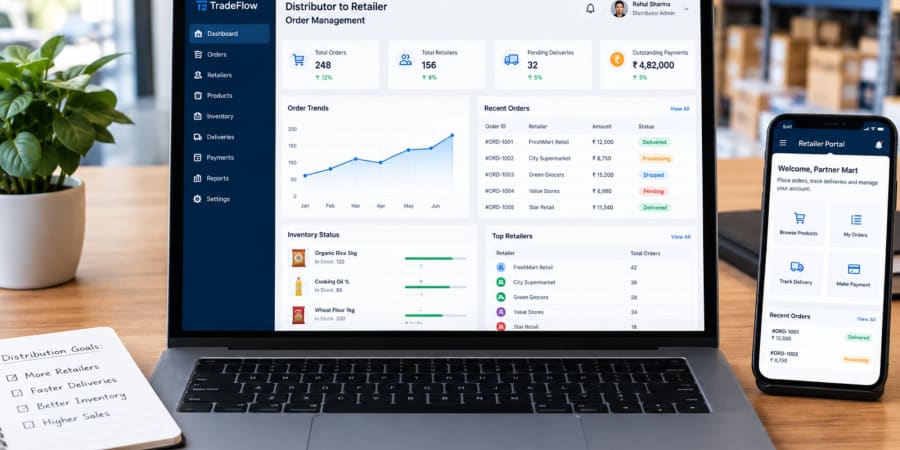
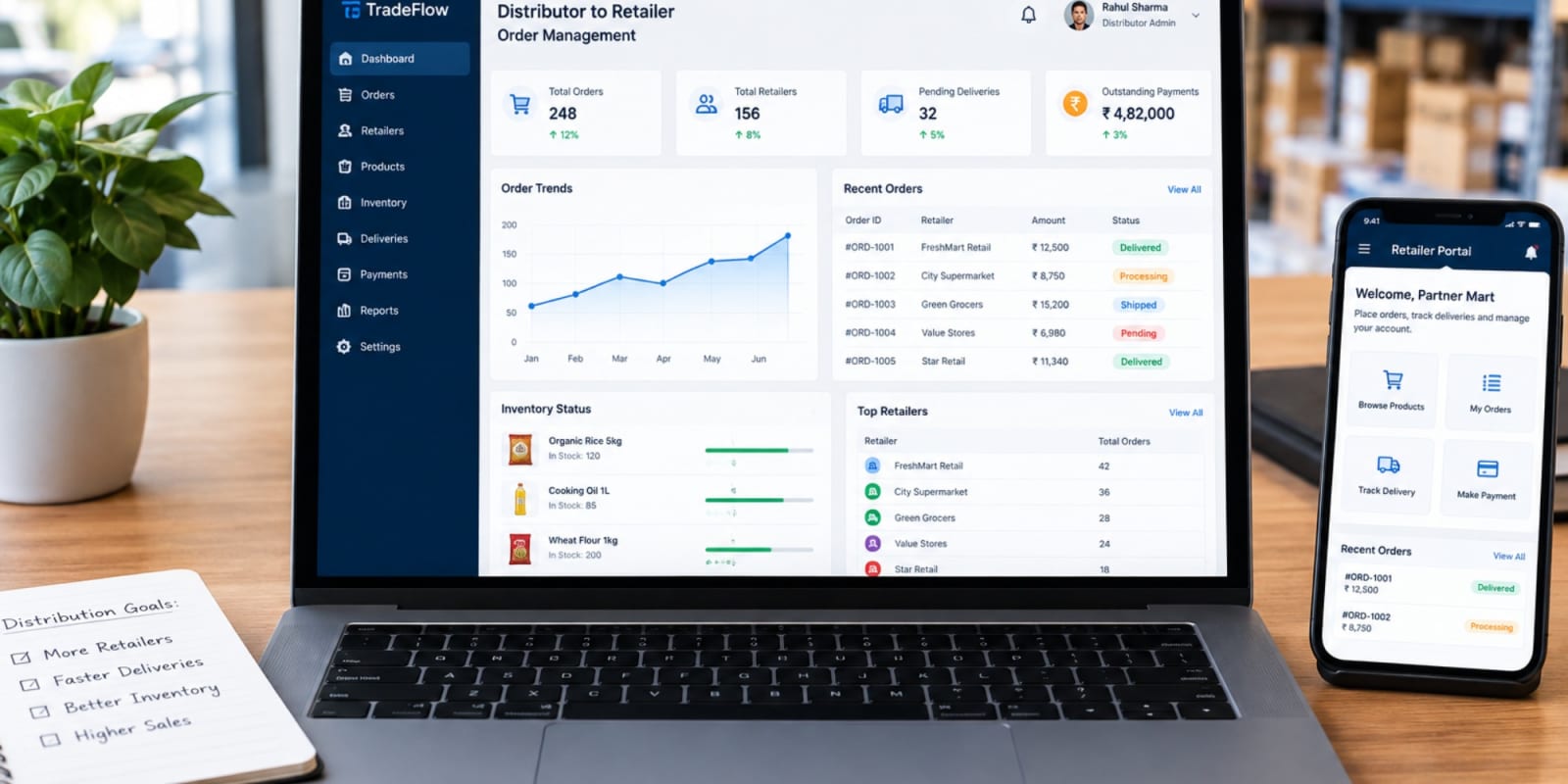
A distributor-to-retailer order management SaaS platform offers a practical way to organise this process. By connecting retailer ordering, stock availability, order processing and delivery updates within a single system, distributors can reduce administrative workload and provide a more consistent ordering experience.
What Is Distributor-to-Retailer Order Management SaaS?
Distributor-to-retailer order management SaaS is a cloud-based application that helps distributors receive, process, fulfil and track product orders from their retail customers.
Instead of depending entirely on sales representatives, phone calls and manually maintained spreadsheets, a distributor can provide retailers with a digital ordering portal. Retailers can browse available products, review their applicable prices, create orders and monitor order status.
On the distributor's side, authorised employees can review incoming orders, check stock, confirm quantities, generate order documents and coordinate dispatch.
How is it different from a basic online store?
A conventional ecommerce store usually focuses on selling products directly to individual consumers. A B2B distribution platform must accommodate repeat orders, customer-specific price lists, minimum order quantities, bulk purchasing, sales representatives, credit terms and delivery schedules.
A specialised SaaS platform can address these business requirements while allowing the distributor to retain control over product availability, pricing and order approval.
Challenges in Traditional Distributor and Retailer Ordering
1. Orders scattered across multiple channels
Retailers may submit orders through calls, messaging applications, emails and sales representatives. Staff then need to consolidate these requests, increasing the risk of missed items, duplicate entries and incorrect quantities.
2. Limited visibility into stock availability
Retailers may request products that are unavailable or already allocated to another customer. Employees need to verify inventory before confirming an order, potentially delaying fulfilment.
3. Manual price verification
Distributors may offer different prices, discounts or minimum order quantities to different customers. When price lists are maintained separately, sales teams may use outdated information or calculate order totals incorrectly.
4. Delayed order processing
Orders may pass through several employees before reaching the warehouse. Without clear statuses and responsibilities, staff can struggle to identify whether an order is awaiting approval, picking, packing or dispatch.
5. Difficult delivery coordination
Distributors serving many retail outlets need to coordinate delivery schedules, vehicle assignments and partial deliveries. Manually maintained records make it harder to identify delayed orders and communicate accurate updates.
6. Fragmented sales and customer records
Customer order histories, outstanding invoices and product preferences may be stored in separate systems. This makes it difficult for business owners to identify repeat-order patterns, inactive customers and products with changing demand.
Why Digital Distribution Matters in 2026
Businesses increasingly expect their suppliers to provide convenient digital interactions. Retailers want to place orders outside traditional sales-call hours, check product availability and receive confirmation without repeatedly contacting a distributor.
At the same time, small distributors need better operational visibility without necessarily investing in a complex enterprise resource planning system.
This creates an opportunity for focused B2B software that integrates ordering, inventory visibility and delivery coordination into a practical workflow.
In Hyderabad and other Indian commercial centres, a product could initially serve a particular distributor category, such as electrical goods, groceries, industrial components or building materials. Once the workflow has been validated, the same product architecture could be adapted for suitable markets across Southeast Asia and the wider Asia-Pacific region.
The opportunity should not be interpreted as an absence of competitors. Existing distribution, ERP and B2B ecommerce platforms already serve parts of this market. A new product needs to differentiate itself through a clearly defined customer segment, simpler implementation, useful integrations or a better fit for local workflows.
How a Distributor-to-Retailer SaaS Platform Works
The platform connects retailers, sales representatives, warehouse staff, delivery teams and administrators through a shared order management workflow.
- Retailer registration: The distributor approves a retailer account and assigns the relevant price list, delivery location and purchasing terms.
- Product selection: The retailer views the authorised catalogue and selects products and quantities.
- Order submission: The platform validates order details and records the request.
- Order review: Distributor staff check stock, pricing, order limits and any applicable credit restrictions.
- Warehouse processing: Approved orders move into picking, packing and dispatch.
- Delivery tracking: The retailer receives order-status updates and delivery confirmation.
- Reporting: The distributor reviews sales, pending orders, fulfilment performance and customer activity.
The first version should prioritise a reliable order lifecycle. More advanced capabilities, such as route optimisation, demand forecasting and accounting integrations, can be introduced after the core process works consistently.
Essential Features of Distributor-to-Retailer Order Management SaaS
1. Centralised product catalogue
Distributors need a structured catalogue containing product names, SKUs, descriptions, units of measurement, pack sizes, prices and availability. Product categories and search filters make ordering easier for retailers with large catalogues.
2. Retailer account management
Each retailer should have an approved account with assigned delivery locations, applicable price lists, order history and authorised users. This helps distributors manage their customer relationships consistently.
3. Digital order placement
Retailers should be able to add products, modify quantities, review totals and submit orders through a responsive mobile or desktop interface. Repeat-order functionality can make frequent purchases faster.
4. Order approval workflows
The system should support configurable order statuses and approval rules. For example, orders exceeding a specified value or requiring special discounts may need a manager's approval.
5. Inventory synchronisation
Stock availability should be updated through a controlled inventory process. If the distributor already uses accounting or ERP software, integration may be preferable to maintaining an independent stock figure.
6. Sales representative management
Sales representatives can receive assigned retailer lists, create orders on behalf of customers and review their sales activity. Permissions should restrict access to the customers and information relevant to each representative.
7. Reports and analytics
Useful reports include sales by customer, products frequently ordered, pending fulfilment, cancelled orders, stock shortages and average order-processing time.
Retailer Ordering Portal: A Convenient B2B Buying Experience
The retailer portal is one of the most important components of the platform because its usability influences whether customers continue placing orders digitally.
A practical retailer portal should include:
- A mobile-friendly product catalogue.
- Search by product name, SKU or category.
- Customer-specific prices and discounts.
- Minimum order quantities and pack-size information.
- Shopping cart and order confirmation.
- Previous orders and quick reorder options.
- Current order status and delivery estimates where available.
- Downloadable order documents and invoices where supported.
Retailers should not see prices, inventory information or commercial terms intended for other customers. Access must be enforced on the server, not merely hidden in the user interface.
Inventory and Stock Visibility for Distributors
Accurate inventory information is essential for dependable order fulfilment. A distributor must know how much stock is available, which quantities have been reserved and whether incoming stock is expected to cover pending orders.
Recommended inventory capabilities
- Product-wise stock records.
- Warehouse and location-level inventory.
- Stock adjustments with a recorded reason.
- Reserved quantities for approved orders.
- Low-stock thresholds and notifications.
- Batch, lot or expiry tracking where relevant.
- Goods received and goods dispatched records.
- Inventory movement history.
Developers should define how the system handles concurrent orders to prevent two retailers from purchasing the same limited stock. Transactions, stock reservations and clear order-expiry rules can help reduce overselling.
If the distributor already has a reliable inventory system, the SaaS platform should ideally use an approved integration or import process rather than create competing stock records.
Customer-Specific Pricing and Credit Tracking
B2B distribution often involves negotiated pricing rather than one universal retail price. Different retailers may receive contract rates, volume discounts, promotional prices or special pack-size arrangements.
A flexible platform may support:
- Retailer-specific price lists.
- Quantity-based discounts.
- Minimum order values and quantities.
- Effective dates for price changes.
- Approval for exceptional discounts.
- Order-level taxes and delivery charges.
- Read-only views of imported outstanding balances.
Some distributors also sell to customers on credit. The initial product can display approved credit terms and outstanding-balance information imported from an accounting system.
Credit decisions, financial records and tax calculations should be handled using verified business rules. The SaaS should not present an estimated balance as an authoritative financial record.
Delivery and Dispatch Coordination
Order management does not end when a retailer submits an order. The distributor must pick products, pack quantities, prepare dispatch documents and coordinate delivery.
Useful delivery features
- Picking lists for warehouse staff.
- Packing and dispatch status updates.
- Vehicle and delivery-team assignment.
- Expected delivery dates and delivery windows.
- Partial shipment and back-order support.
- Proof of delivery through a signature or photograph.
- Delivery exception and failed-delivery records.
- Notifications when orders are dispatched or delivered.
Route optimisation can be a future feature for distributors with multiple daily deliveries. It should be introduced when the team understands delivery constraints, geographic coverage and the actual cost of inefficient routing.
Automation and AI Opportunities in B2B Distribution
Automation can reduce repetitive work, but it should support a reliable order process rather than complicate it.
Automated order reminders
The system can notify retailers about pending draft orders, order confirmations or upcoming delivery windows, subject to their notification preferences and applicable consent requirements.
Repeat-order suggestions
Based on previous purchases, the platform can display products a retailer frequently orders. Suggestions should be clearly distinguished from confirmed orders.
Sales forecasting
Historical order data can support simple demand forecasts and reorder suggestions. Forecasts should account for seasonality, stockouts and changes in customer behaviour, and should not be treated as guaranteed demand.
Document extraction
Optical character recognition and AI-assisted extraction may help convert order sheets or purchase orders into draft order records. Staff should review extracted products, quantities and prices before final submission.
Automated exception alerts
Rules can flag unusual discounts, repeated cancellations, delayed orders or unexpected stock changes. Authorised employees should review significant exceptions before taking action.
Industry Use Cases Across India and Asia-Pacific
Grocery and FMCG distribution
Retailers can reorder packaged foods, household products and fast-moving consumer goods. Useful features include pack sizes, promotional pricing, expiry tracking and frequent repeat orders.
Electrical and industrial components
Component distributors can manage SKUs, technical specifications, minimum order quantities and customer-specific pricing. Product search and accurate item identification are particularly important.
Building materials and hardware
Distributors can coordinate bulk orders, delivery locations, material availability and partial deliveries for retailers and contractors.
Pharmaceutical and healthcare supply distribution
A specialised version could support authorised customers, batch and expiry information, traceability and controlled product catalogues. Pharmaceutical distribution has additional regulatory and data requirements that must be addressed before deployment.
Food service and hospitality suppliers
Suppliers serving restaurants, cafes and caterers can support recurring orders, delivery windows, unit-based pricing and stock-sensitive substitutions.
Expansion across Asia-Pacific
Once the product works for one segment in India, potential expansion markets may include Malaysia, Singapore, Indonesia, the Philippines and Vietnam. Each market requires customer validation and appropriate localisation, including currencies, languages, taxes, privacy requirements and local integrations.
Business Benefits of Distributor Order Management SaaS
For distributors
- Fewer manually re-entered orders.
- Better visibility into incoming demand and pending fulfilment.
- More consistent customer-specific pricing.
- Improved coordination between sales, warehouse and delivery teams.
- Centralised customer and order histories.
- More useful reporting on sales and fulfilment performance.
For retailers
- Convenient ordering through a digital portal.
- Faster access to applicable prices and product information.
- Easier repeat ordering.
- Clearer order confirmations and status updates.
- Reduced need to contact sales staff for routine updates.
For sales representatives
- Better access to assigned customer information.
- Less time spent consolidating orders manually.
- More consistent records of customer requests.
- Improved visibility into follow-ups and order outcomes.
Actual benefits depend on how well the software fits existing workflows, the accuracy of the underlying data and whether retailers and staff consistently use the platform.
Building a Distributor-to-Retailer SaaS MVP with Full-Stack Developers
A small team of interns or junior developers can build an initial version if it focuses on the core ordering workflow and receives appropriate technical review.
Phase 1: Build the essential modules
- User authentication and role-based access.
- Distributor and retailer management.
- Product catalogue and pricing.
- Order creation and approval.
- Basic stock availability.
- Order status tracking.
- Simple reports and CSV exports.
Phase 2: Add operational improvements
- Warehouse picking and dispatch workflows.
- Delivery assignment and proof of delivery.
- Repeat-order functionality.
- Automated notifications.
- Customer-specific discounts.
- Import and export integrations.
Phase 3: Expand based on customer demand
- Accounting or ERP integrations.
- Advanced inventory synchronisation.
- Multi-warehouse operations.
- Demand forecasting and replenishment suggestions.
- Route optimisation.
- Additional languages and regional configurations.
An initial MVP may take approximately six to ten weeks for a small, capable team, depending on prior experience, integration requirements and the amount of testing required. A production-ready product will require further development, security review and customer support.
Recommended Technology Stack
A modern web stack can support the retailer portal, distributor dashboard and administrative tools without requiring a large engineering team.
- Frontend: React, Next.js and TypeScript.
- Backend: Next.js server-side functions or Node.js with Express or NestJS.
- Database: PostgreSQL.
- Database ORM: Prisma or Drizzle.
- Authentication: A suitable managed authentication provider or securely implemented authentication.
- File storage: Object storage for documents and delivery evidence.
- Hosting: Managed application hosting and a managed database.
- Testing: Unit, integration and end-to-end tests.
- Version control: Git and GitHub.
Important engineering considerations include tenant-level data isolation, secure server-side permissions, transactional stock updates, audit logs, database backups, monitoring and recovery procedures.
Avoid building a complicated microservices architecture for the first version. A well-structured modular application is generally easier for a small team to maintain.
Implementation Roadmap for a Distributor SaaS Platform
Weeks 1–2: Business discovery
- Interview distributors and retailers.
- Map the existing ordering and fulfilment process.
- Identify the most expensive or error-prone steps.
- Research competing platforms and existing alternatives.
- Define the target industry and MVP requirements.
Weeks 3–4: Prototype and architecture
- Design the retailer and distributor interfaces.
- Define database entities and permissions.
- Create a clickable prototype.
- Test the order lifecycle with prospective customers.
Weeks 5–8: MVP development
- Implement authentication and account management.
- Build the catalogue, pricing and order modules.
- Implement order validation and stock controls.
- Add basic reports and notifications.
- Test key permissions and failure scenarios.
Weeks 9–10: Pilot and improvement
- Onboard a small number of pilot distributors.
- Test the product with real retailer orders.
- Monitor errors and order-processing times.
- Gather user feedback and prioritise fixes.
- Evaluate willingness to pay before expanding the feature set.
This timeline is illustrative. Existing integrations, legacy data, complex pricing rules and inventory accuracy requirements may extend the project.
SaaS Pricing and Revenue Models
A distributor-to-retailer platform can use a subscription model based on business size, number of users, locations or order volume. The best model depends on customer value and operating costs.
Possible pricing structure
- Starter: Basic catalogue, retailer accounts and order tracking for small distributors.
- Growth: Customer-specific pricing, staff permissions, stock controls and reports.
- Business: Multiple warehouses, advanced integrations and detailed analytics.
- Onboarding services: Optional setup, data migration, training and custom configuration.
Illustrative monthly revenue scenarios
These figures are examples only, not established market prices or guaranteed outcomes.
| Paying distributors | Monthly fee per distributor | Monthly recurring revenue |
|---|---|---|
| 10 | ₹2,000 | ₹20,000 |
| 25 | ₹3,000 | ₹75,000 |
| 50 | ₹5,000 | ₹2,50,000 |
| 100 | ₹5,000 | ₹5,00,000 |
Revenue is not profit. Hosting, customer support, development, onboarding, sales, payment fees, taxes and other operating expenses must be accounted for when assessing commercial viability.
Challenges and Implementation Considerations
Data migration
Distributors may have inconsistent product codes, duplicate customer records or outdated price lists. Clean and validate imported data before using it for live orders.
Inventory accuracy
Digital ordering will not solve stock problems if the underlying inventory records are incorrect. Define how stock movements, reservations and adjustments are recorded.
User adoption
Retailers may prefer familiar ordering methods. Provide simple onboarding, convenient repeat orders and clear order confirmations to encourage adoption.
Security and privacy
Customer records, negotiated prices and commercial documents require suitable access controls, secure storage and data protection practices.
Integration complexity
Accounting, payment and messaging integrations may require third-party approvals, ongoing maintenance and additional costs. Start with the integrations that solve the most important validated customer problem.
Frequently Asked Questions
1. What is distributor-to-retailer order management software?
It is software that helps distributors manage retailer accounts, product catalogues, customer-specific pricing, order processing, inventory visibility and delivery coordination through a shared digital system.
2. How is B2B order management different from ecommerce?
B2B order management commonly supports negotiated pricing, bulk orders, repeat purchases, customer-specific terms, sales representatives, approval workflows and business deliveries. These requirements can differ from a consumer ecommerce store.
3. Can small distributors benefit from a SaaS platform?
Yes, when the platform solves a real operational problem and its cost is justified by reduced manual work, improved visibility or better order processing. Suitability depends on the distributor's size, workflows and existing software.
4. Can interns build a distributor order management MVP?
A small team of full-stack developers can build a limited MVP with a product catalogue, retailer accounts, order submission, approval and basic stock controls. Experienced technical review is important before handling live commercial data.
5. Does the SaaS need to replace an existing ERP?
Not necessarily. It can function as a retailer ordering and workflow layer that integrates with an existing ERP or accounting system. Integration is often preferable to duplicating financial and inventory records.
6. Can this platform work across India and Asia-Pacific?
Yes, provided the platform is adapted for each target market. Country-specific currencies, taxes, languages, payment systems, privacy obligations and operational practices must be considered.
7. How can a distributor SaaS make money?
Common approaches include monthly or annual subscriptions, feature-based pricing, per-location plans and optional onboarding or integration services. Pricing should be tested with actual potential customers.
8. What makes a distributor SaaS different from competitors?
Potential differentiators include a focused industry workflow, faster implementation, mobile-first ordering, reliable stock synchronisation, local integrations and simpler pricing. These advantages should be validated against the products customers already use.
Conclusion: Building a More Connected B2B Distribution Network
Distributor-to-retailer order management SaaS can help businesses organise product ordering, pricing, inventory visibility and delivery coordination in one connected workflow.
For distributors in Hyderabad and other Indian commercial centres, the most practical starting point is a clearly defined industry and a small set of features that solve a recurring operational problem. Once the workflow has been validated with real customers, the platform can expand through integrations, automation and additional market-specific features.
Young full-stack developers can use this opportunity to develop practical B2B software skills while learning how to turn customer problems into maintainable commercial applications.
The long-term opportunity is not simply to digitise order entry. It is to help distributors and retailers work together with better information, fewer avoidable errors and more predictable business processes.
Looking to Build a Custom B2B SaaS Platform?
Nextcode helps businesses explore digital solutions, workflow automation and custom software development. If your distribution business needs a retailer ordering portal, inventory dashboard, procurement workflow or integrated B2B platform, start with a clear assessment of your operational requirements.
Discuss your business process, intended users and essential features to identify an appropriate development approach.